The argument: LAC has relatively strong access to AI, but access alone may not determine whether the region captures its economic benefits.
The Question: Can AI Support Economic Convergence in LAC?
Latin America and the Caribbean (LAC) has historically struggled to sustain meaningful levels of economic growth, despite possessing characteristics that are economically advantageous. For example, the region is richly endowed with natural resources, but many economies remain highly dependent on commodity exports, leaving them exposed to fluctuations in global raw-material prices. Similarly, LAC has high rates of entrepreneurship, but this does not translate into widespread productivity gains given the concentration of small, micro-enterprises with minimal scalability. Furthermore, the region is uniquely exposed to climate change related events (especially in the Caribbean), which can create economic setbacks despite growth efforts.
Interestingly, there are two emerging hypotheses regarding the macroeconomic effects of AI adoption and advancement globally, and these approaches are not mutually exclusive. The first posits that global advancement and diffusion of AI technology may exacerbate economic inequalities that already exist on a global scale. The second (and more promising outlook) suggests that AI may create distinct opportunities to level the economic playing field – countries who were previously disadvantaged can leverage the technology to support economic convergence, provided that a set of complementary capabilities and enablers are present. This poses the question – what determines whether LAC will see meaningful gains from the rapid global development and diffusion of AI technology?
Research about the economic gains attributable to AI (at an organization level and a macroeconomic, country level) demonstrate the nascency of this technology at scale – few organizations have truly moved past experimentation and piloting into deeper AI integration. McKinsey’s State of AI Global survey shows that two thirds of companies are still in the experimenting and piloting phase, and have not yet begun scaling the technology throughout the enterprise. It is therefore unrealistic to make assertions about the true determinants of AI integration, but it may be possible to begin predicting integration levels by thinking through AI access and adoption.
From Access to Economic Gains: A Simple Framework
In this piece, AI integration is preceded by two conditions – AI access and adoption. Naturally, AI access to some extent is precursive to AI adoption, but they are likely to evolve at the same time. Broadly, a simple framework to conceptualize the process of (an organization or country) achieving economic gains could be defined as follows: broad AI access → AI adoption → AI integration/diffusion → productivity and economic gains. AI access, adoption, and diffusion do not have widely agreed upon definitions, but functional definitions within this framework could be as described below.
- AI access: Individuals have the ability to use AI solutions, including access to the necessary tools, connectivity, infrastructure, and skills (i.e., Can individuals or organizations use AI solutions?)
- AI adoption: People or groups are adding AI tools into their daily work and systems. Often takes the form of experimentation and piloting – applies to GenAI technologies, agentic AI (Are individuals and organizations actually using the AI solutions accessible?)
- AI integration: AI adoption has spread across groups within an enterprise and throughout an industry/sector – it is deeply integrated into workflow/processes and embedded into core business functions (i.e., How deeply is AI embedded into workflows and core organizational processes?)
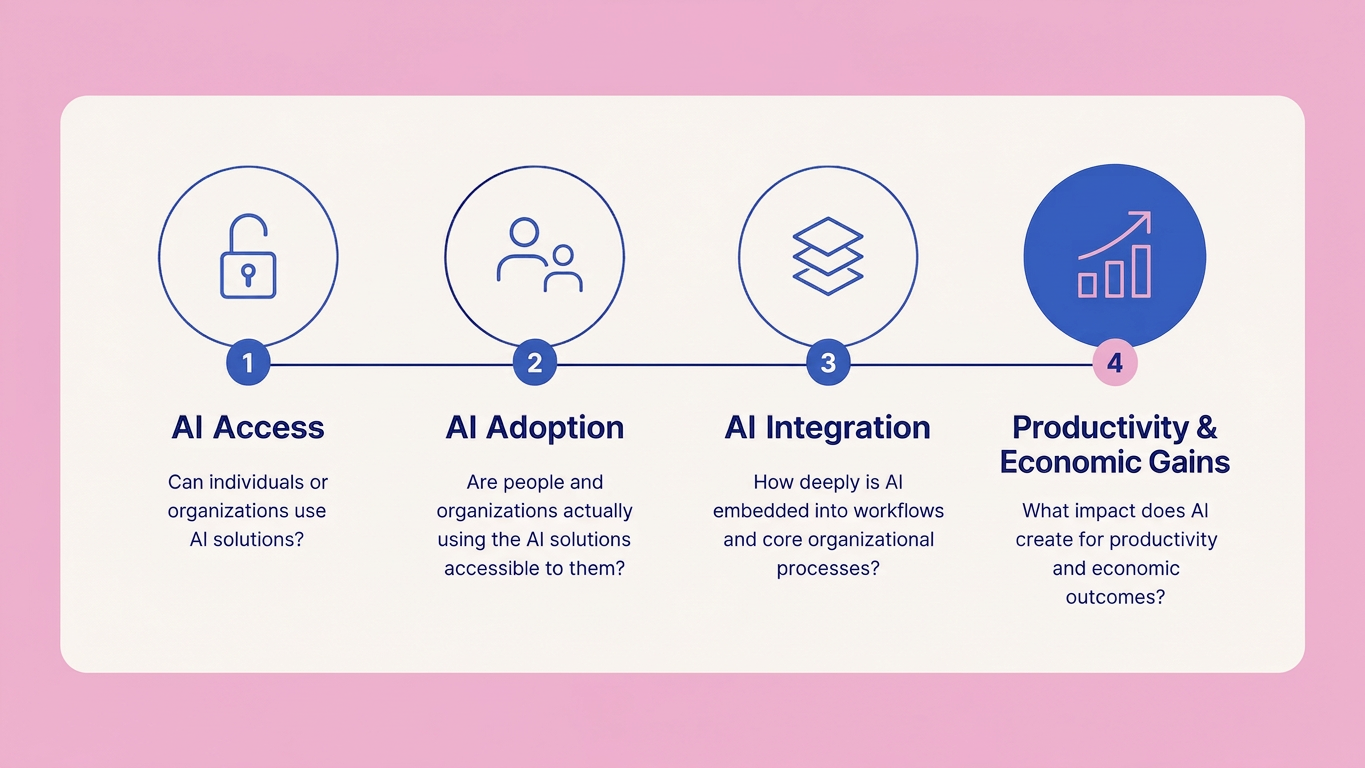
Within the context of this framework, I aim to conceptually explore LAC’s current standing and trajectory regarding AI access and adoption, and what these conditions might suggest around the region’s ability to achieve deep AI integration and realize economic gains attributed to this.
AI Access: Is the Region Punching Above Its Weight?
Can individuals or organizations use AI solutions?’
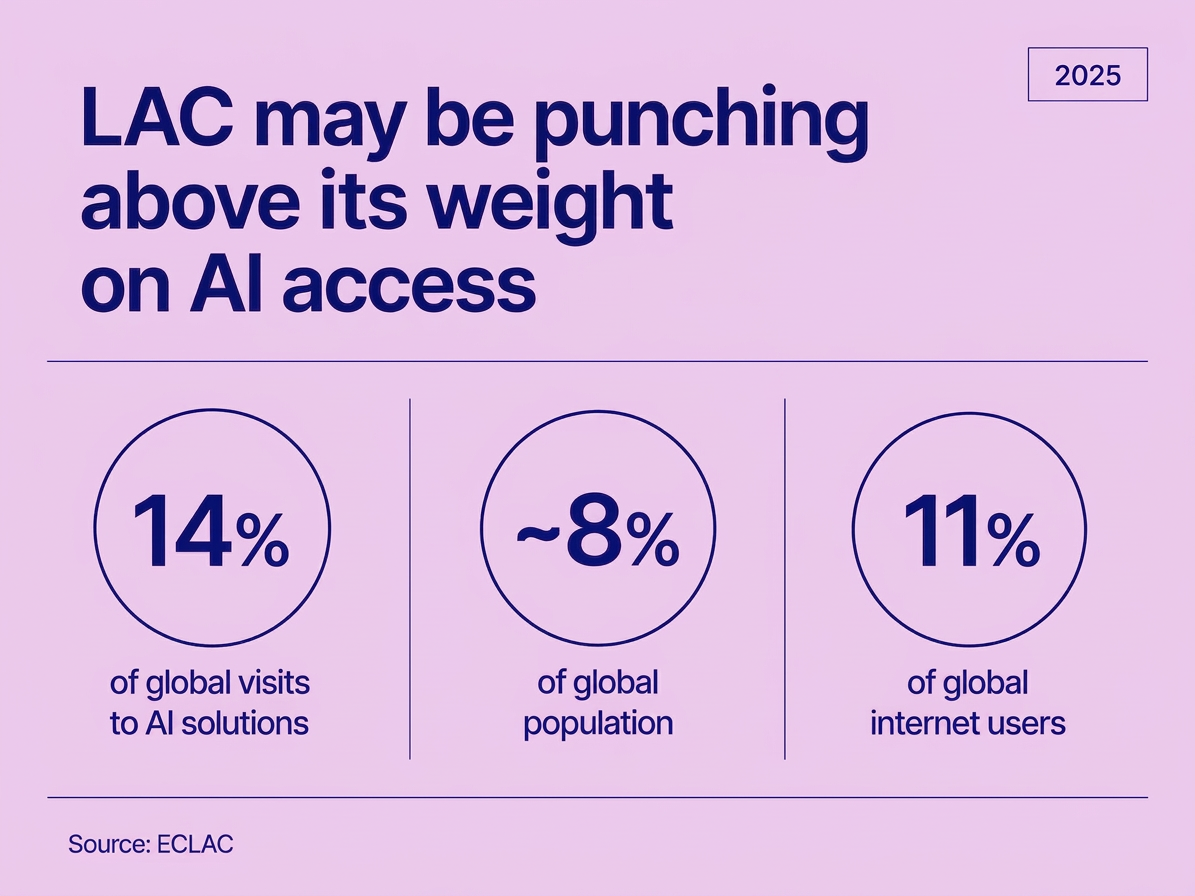
From a regional lens, LAC might be ‘punching above its weight’ in terms of access – research from the Economic Commission for Latin America and the Caribbean (ECLAC) stated that in 2025, the region accounted for 14% of global visits to AI solutions, which is notable given that the region accounts for ~8% of the global population and 11% share of the world’s internet users. Importantly, Generative AI is particularly accessible – findings from the Latin America Artificial Intelligence Index (ILIA) states that LAC ranks third in Generative AI application downloads (15-20%). Business-level usage is broadly aligned with individual usage findings – according to Inter-American development bank, 80% of LAC businesses surveyed by the Inter-American development Bank said that they were using AI tools.
The Access Gap Within the Region
While the regional view is optimistic, intra-regional variance in digital infrastructure and connectivity persist. The 2025 ILIA study graded 19 countries (1-100) across a variety of ‘enabling factors’ (including infrastructure,data and human talent) – and found that 11 of the 19 countries scored under 50 – highlighting gaps in more digitally-mature countries like Chile, Brazil, and Uruguay compared to peers like Cuba, Honduras, and El Salvador.
This digital infrastructure gap has real consequences for AI adoption, as it means that even where jobs would theoretically be highly exposed to GenAI (and other AI solutions), workers lack the ability to use tooling consistently and meaningfully. 2025 analysis from the World Bank states that in the LAC region, while 8-12% of jobs theoretically could see Gen-AI related increase in productivity, half won’t be able to leverage the benefits due to the lack of digital infrastructure.
Therefore, region-level access for AI technology is quite high, especially with the rise of Generative AI, but access varies significantly amongst individual countries. Uneven development of digital infrastructure remains a hindering factor to closing AI access gaps and making ‘practical’ access commonplace.
AI Adoption: Are Firms Actually Using What They Can Access?
‘Are individuals and organizations actually using the AI solutions accessible to them?’
To understand the current extent of AI adoption in LAC and where adoption might be headed, I began by looking into which industries dominate the region’s economy, and the degree to which those industries are exposed to AI globally. My thinking was simple – AI adoption may be higher if the region is dominant in sectors where there are high global rates of AI exposure.
In looking at the region’s GDP value added distribution by sector, the macro picture shows that the five largest sectors are as follows: Financial intermediation (21% of value added GDP), Social and personal service, which includes public administration, education, social work, and human health (18%), wholesale and retail trade (18%), manufacturing (16%), and transportation, storing and communications (8%).
In looking at global AI exposure trends, there is consensus that knowledge intensive industries have the highest exposure to AI. PwC’s AI Jobs Barometer ranks the sectors with the highest AI exposure globally, with financial services at the top, followed by information and communication, professional, scientific and technical activities, real estate, education, public administration, mining, and human health and social work.
Although the sectors across sources do not map neatly to one another, it appears that the region’s largest sectors by GDP contribution (such as financial intermediation, education/human health/social work activities, and wholesale/retail trade) of LAC are aligned to sectors within the top 10 AI exposure ranking. Therefore, the regional economy appears to be composed of sectors that have high exposure to AI globally.
Exposure Does Not Necessarily Translate Into Adoption
The insight from this ‘scrappy’ comparison is aligned to data from 2025 World Bank estimates, which state that 30-40% of jobs in the region are exposed to Generative AI. This prompts the question; Does this exposure typically translate into adoption? Analysis from the National Bureau of Economic Research reveals that AI exposure does not directly translate into AI adoption. Importantly, the analysis revealed that AI adoption occurs when the AI has become more productive than the person at the task and simultaneously cheaper than the human labor equivalent (i.e., a comparative advantage exists).
Why Adoption May Be Constrained in LAC
Ultimately, LAC’s AI adoption appears low, and this may be attributed to several different constraints. As discussed prior, the digital infrastructure remains a significant challenge, but when we overlay the lens of comparative advantage, the story becomes more nuanced. In particular, where connectivity and foundational IT infrastructure remain uneven, the cost of deploying and scaling AI solutions is likely to remain relatively high, limiting the ability of firms to build economies of scale around the technology. This can create something of a circular problem: weaker digital infrastructure constrains consistent use, inconsistent use limits experimentation and scale, and limited scale keeps the economics of AI solutions relatively unattractive. Therefore, it is difficult to derive the aforementioned comparative advantage from the technology given cost barriers.
The Role of SMEs, Infrastructure, and Investment
Another constraining factor may be the structure of LAC’s private sector may reinforce this dynamic, which is dominated by small businesses. SMEs account for roughly 60% of formal productive employment in the region, however, globally it has largely been bigger firms leading AI adoption; OECD data suggests that 39% of large firms used AI in 2024, compared with just 12% of small firms. SME dominance in itself may not be the problem, but rather the fact that smaller firms in LAC are often less digitally mature and therefore less prepared to integrate new technologies. I have observed this experientially in Guyana, Jamaica, and Trinidad, where many small businesses (including those in urban areas) operate with little or no digital presence.
More broadly, existing research points to a recurring set of themes around determinants of AI adoption globally, including digital infrastructure, private-sector investment, workforce readiness, and government and regulatory support. On each of these dimensions, LAC continues to face gaps: the IDB estimates that roughly US$70 billion in additional digital infrastructure investment would be needed to close connectivity gaps with OECD economies, while the region has attracted only about 1.1% of global AI investment, Taken together, this suggests that low adoption in LAC is not fully determined by technological access, but whether firms operate in an environment where the technology can be used consistently, afforded, scaled, and supported by the necessary skills, investment, and institutional capacity
AI Integration: What Would It Take to Move Beyond Experimentation?
How deeply is AI embedded into workflows and core organizational processes?’
As mentioned prior, it is tricky to make assertions about the determinants of AI integration at this particular point in time – the global ‘runway’ for this phase of development is significant. Interestingly, there is early research that points to several factors which ‘interact’ with AI adoption rates to determine the extent of economic gains achieved. Amongst these factors include financial innovation (i.e., development of payment infrastructure, accessibility of credit and other financial instruments) and trade openness (i.e., the willingness of the country to participate in international commerce and the global economy). As AI Adoption data for LAC region becomes available, historical data for these interaction variables can help to make stronger predictions around the economic growth trajectory that the LAC region observes.
Ultimately, Adoption May Matter More Than Access
In conclusion, LAC’s ability to capture economic gains from AI will depend less on AI access, and more on the region’s adoption pattern. At the regional level, access is decent, but adoption is weak due to persistent infrastructure gaps, limited private investment, uneven digital maturity, and an SME-heavy private sector may be slow to transition.
Sources
- Inter-American Development Bank. 2024 Latin American and Caribbean Macroeconomic Report: Ready for Take-off? Building on Macroeconomic Stability for Growth. 2024.
- World Bank. Latin America and the Caribbean Economic Update. 2026.
- World Bank. “How the World Bank’s Crisis Toolkit Is Empowering Caribbean Small States.” April 28, 2025.
- United Nations Development Programme. The Next Great Divergence: Why AI May Widen Inequality Between Countries. December 2, 2025.
- McKinsey & Company. “The State of AI in 2025: Agents, Innovation, and Transformation.” November 5, 2025.
- Economic Commission for Latin America and the Caribbean (ECLAC). “Latin America and the Caribbean Accelerate the Adoption of Artificial Intelligence, though Challenges Remain in Investment, Talent, and Governance.” October 3, 2025.
- Economic Commission for Latin America and the Caribbean (ECLAC). Latin American Artificial Intelligence Index (ILIA) 2025. Digital Development Observatory, updated October 2, 2025.
- Inter-American Development Bank. “Will AI Boost Productivity—or Widen Inequality?” July 27, 2026.
- World Bank. “Quantifying the Jobs Potential of AI in Latin America and the Caribbean.” April 15, 2025.
- Economic Commission for Latin America and the Caribbean (ECLAC). “Regional Profile: Economic Statistics.” CEPALSTAT Statistical Database and Publication, 2026.
- Lindenlaub, Ilse, Ryungha Oh, Maria Alejandra Rodriguez, and Laura Veldkamp. “Beyond Exposure: Predicting AI Adoption Based on Comparative Advantage.” NBER Working Paper 35271, 2026.
- OECD. Emerging Divides in the Transition to Artificial Intelligence. 2025.
- “Artificial Intelligence and Economic Growth in G20 Economies: Investigating Nonlinear Effects Through a GMM Method.” Humanities and Social Sciences Communications, 2026.


Leave a comment