An inquiry into agentic loops and the changing role of research in strategy work
The argument: There is an opportunity for AI use in strategy research to deepen beyond initial thematic scans.
Agentic loops could allow strategists to delegate more detailed research where the required output, quality standards and stopping points can be clearly defined. However, the parameters chosen will shape what the research captures and what it omits.
This means that human judgement remains critical in deciding what to investigate and whether the findings actually address the strategic question. This may also shift the role of dedicated research and insights teams, with greater emphasis on specialized sources, research design and quality assurance.
Strategy professionals, including management consultants and corporate strategy teams, are currently trying to understand how AI tools can drive efficiency in their daily work, but also what unique value human expertise brings when access to LLMs is widespread.
An oversimplified version of strategy work involves defining the problem, gathering inputs, analyzing those inputs, determining the “so what,” and making decisions about the future state and how to achieve it. In practice, these activities are iterative. Here, I aim to explore how AI use may evolve and deepen within the research phase – the process of gathering inputs and closing critical evidence gaps.
In the field, I am seeing strategy professionals use LLMs for a first ‘layer’ of research. If a bank is looking to strengthen its competitive position relative to peer financial institutions, for example, I may use Claude or ChatGPT to ask: “How does Bank X’s first-time homebuyer process and offering compare to those of banks of similar size?”
At this stage, the question is open-ended. The output helps me understand potential thematic differences: perhaps around digital convenience, advisory support or incentives – and gives me a starting point for further investigation. I then have to exercise human judgement to determine what to pursue and where to dig deeper. The findings are provisional, but accuracy still matters, given that an incorrect first pass can send the subsequent work in the wrong direction.
The usefulness of this initial exploration also depends on the “inside knowledge” and contextual clues available to the strategist. These may include the strategic vision of the business line, internal targets, changes in leadership, tensions with other teams, and an understanding of existing and past initiatives. A theme that appears compelling externally may have little relevance internally, or may represent an opportunity that the organization has already tried to pursue.
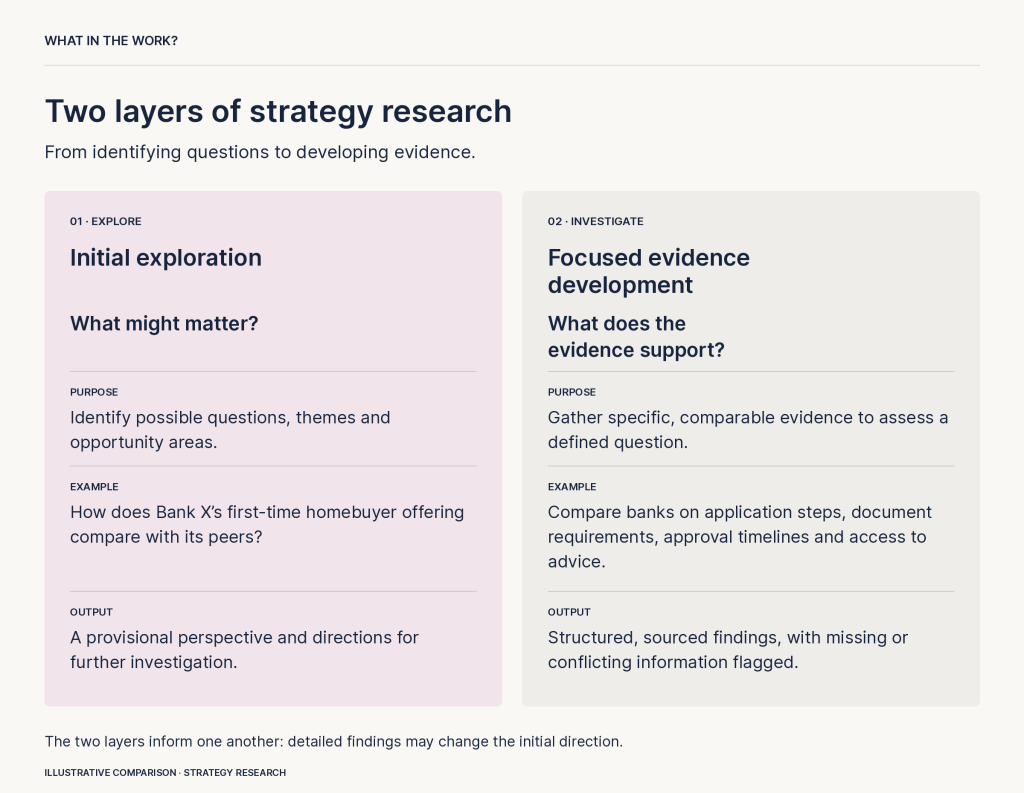
Alongside using LLMs for first passes at broad questions, there is an opportunity to delegate more of the detailed research that follows. Some of this work involves repeatedly collecting the same fields, checking whether the information meets a defined standard, and returning to unresolved gaps.
I believe that this is a promising use case for agentic loops: research tasks where the strategist can define the required output, establish what counts as sufficient evidence, and give the system a checkable finish line.
As gathering information becomes easier, the judgement involved in specifying the research becomes more important. The strategist still has to determine which companies belong in the comparison, which datapoints matter, and what standard of evidence would be sufficient to assess the opportunity. These choices shape the findings before the research begins.
How does an agentic loop work?
To clarify this concept, I drew upon explanations provided by both Anthropic and IBM:
- Agentic loops: Processes in which an AI system takes an action, observes the result and uses feedback to determine its next step, repeating until the task is complete or a stopping condition is reached
- Loop engineering: The practice of designing these processes, including their goals, available tools, feedback mechanisms and stopping criteria
For the research tasks discussed here, I would assess suitability for an agentic loop against four conditions:
- Defined completion criteria: Required output can be clearly defined and completion can be verified.
- Actionable evaluation: During iteration, the system can identify which criteria failed and what needs to be resolved.
- Capacity to address gaps: The system has access to the tools, sources and retained results needed to act on the feedback and make progress toward completion (e.g., it can research missing fields to address gaps)
- Bounded execution: The system has clear stopping points that it can abide by – meaning it will stop when it achieves the target (completion criteria met) or a cost / iteration / time limit has been hi
In practice: Mapping skincare competitors (example)
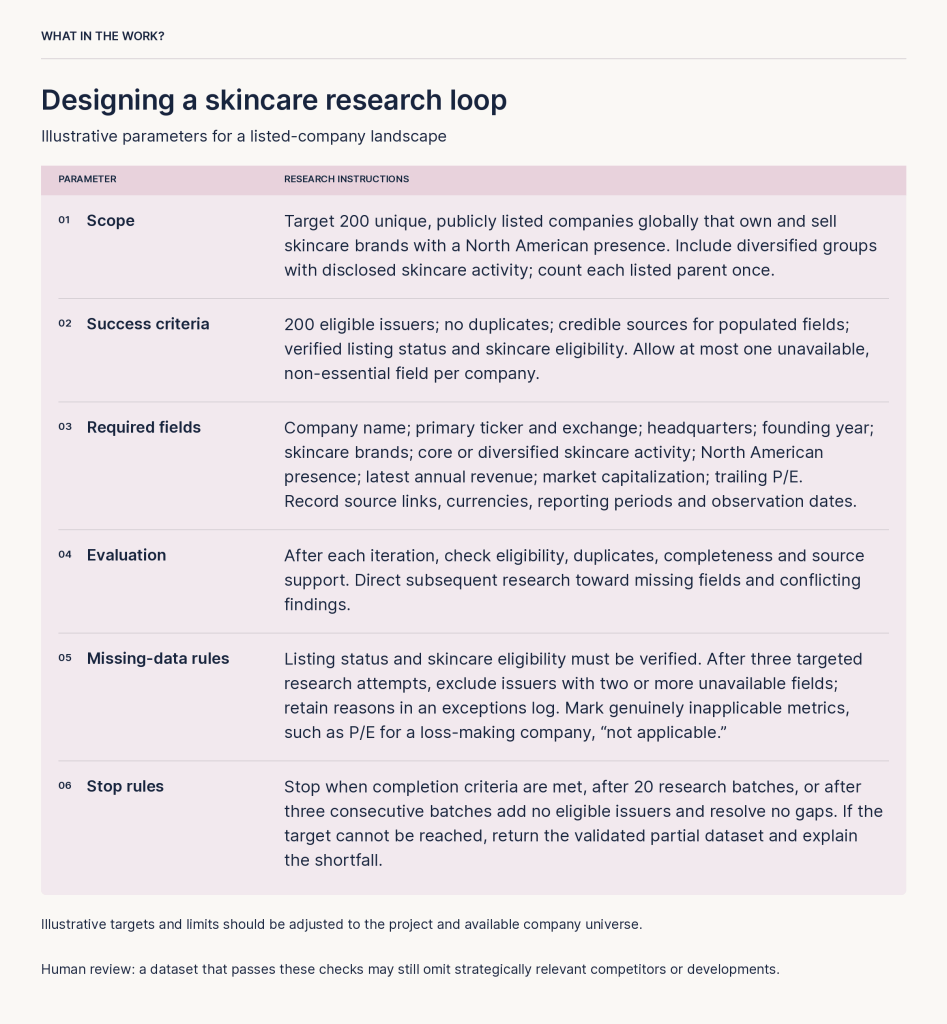
A strategy consultant conducting due diligence for a private equity firm entering the North American beauty and skincare market may want to map a target’s competitors. An agentic loop could support this work by building a structured dataset of publicly listed companies with skincare activity, using defined inclusion criteria, required fields and validation checks.
Why do the parameters matter?
An agentic loop may complete the task specified above, but meeting the completion criteria doesn’t necessarily produce a sufficient answer to the strategic question. For example:
- The inclusion criteria will shape the competitive landscape captured. Focusing on publicly listed companies excludes private competitors, while removing companies with limited disclosures may bias the dataset toward better-documented firms. This is problematic given that these may not be the companies most comparable to the target.
- The required fields will shape what the dataset contains and reveals. A dataset focused on company profiles and financial metrics may overlook recent strategic moves, such as skincare companies expanding into makeup or fragrance verticals. Unless these developments are explicitly stated within the research requirements, the output may miss information relevant to assessing the target’s competitive position.
Therefore, human judgement is still critical in both designing the research parameters and thinking beyond the ‘sandbox’ about what is relevant. While AI tools can aid this process, domain expertise and human reasoning skills may be the differentiating factor in the quality of the answer.
Other research use cases
Alternative research applications (and examples) within the research phase of strategy work may include:
- Developing company landscapes: Identify North American companies offering AI-enabled mortgage underwriting software, recording their target customers, product capabilities, ownership and publicly disclosed bank clients.
- Reviewing transaction history: Build a dataset of acquisitions of North American life insurers by asset managers over the past 10 years, recording the buyer, target, announcement date, disclosed transaction value and publicly stated strategic rationale.
- Conducting competitor benchmarking: Create a feature matrix comparing travel rewards credit cards in Canada and the United States, including annual fees, earn rates, welcome offers, redemption options and travel benefits.
- Testing key trends: Gather and triangulate evidence to assess whether (and where) the Canadian housing market is slowing, using indicators such as sales volumes, new listings, inventory, prices and mortgage originations.
The above use cases work given that each task can be bounded by a defined scope, required fields, source standards and completion checks, with subsequent iterations directed toward unresolved gaps.
What does this mean for research teams?
Importantly, both in-house strategy teams and consulting firms often rely on dedicated research and insights (R&I) teams for research at this depth, given the time and specialist knowledge it requires. If strategists are empowered to undertake more of this work themselves through agentic loops, the value proposition of an R&I team may shift. This may place greater emphasis on speed of delivery and access to specialized knowledge sources, such as paid industry reports, financial databases (e.g. S&P Capital IQ Pro) and proprietary benchmarking services (e.g., Finalta by McKinsey) . As the volume of AI-generated research grows, there may also be a greater role for R&I teams in helping strategists design the research, resolve conflicting evidence and assess whether the findings are sufficient for the question at hand.
Sources:
- Anthropic. “Building effective agents.” December 19, 2024. Read source
- Belcic, Ivan, and Cole Stryker. “What is loop engineering?” IBM Think, July 17, 2026. Read source


Leave a Reply